Detection
of the eclipsing dwarf nova nature of SDSS J122740.83+513925.0
On 2007, June 4th, I was informed by Patrick Schmeer
about his detection of an outburst of SDSS
J122740.83+513925.0 on June 4.106 UT at unfiltered
mag 15. This object was discovered in the course of
the SLOAN Digital Sky Survey and is reviewed in "Cataclysmic
Variables from Sloan Digital Sky Survey. V. The
Fifth Year (2004), Szkody et al.". Based on
a communication with Arne Henden, one of the
co-authors of this paper, SDSS J122740.83+513925.0
is known as a CV, and is probably a high-inclination
dwarf nova with a low orbital period.
Following Patrick's announcement, I started
time-series CCD observations of SDSS
J122740.83+513925.0 on June 4/5, 2007 at CBA Belgium
Observatory, using one of the observatory's 0.35-m
f/6.3 telescopes. My observations cover a time span
of 3.0 hours. They clearly show the presence of two
eclipses, superimposed on another periodic
modulation, hence classifying SDSS
J122740.83+513925.0 as an eclipsing dwarf nova.
Using Peranso,
I find an orbital period of 0.0624 +/- 0.0001 d
or 90 min (extremum determination based on the
Kwee-van Woerden method and on a Polynomial fit).
The eclipses have a depth of 0.5 mag.
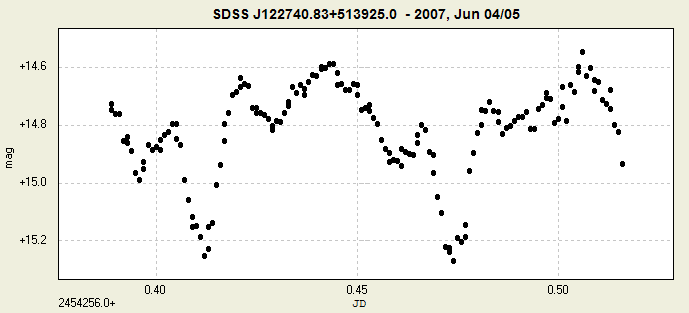
Lightcurve of SDSS
J122740.83+513925.0 on 2007, Jun 04/05,
showing the presence of 2 eclipses, superimposed on
another periodic modulation.
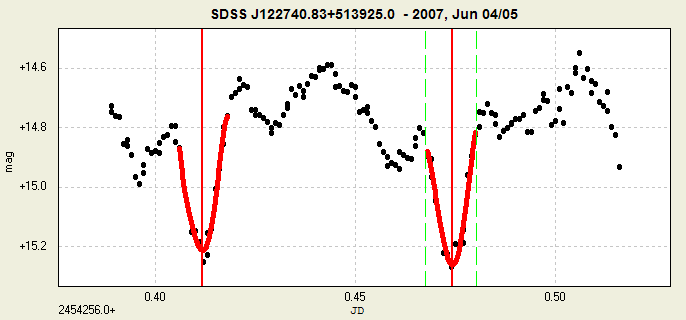
The orbital period of the system has
been determined using Peranso's Kwee-van Woerden
and Polynomial Fit methods (the latter one is
depicted above).
SDSS J122740.83+513925.0 appears to be a very
interesting system, so I encourage follow-up
photometry, to further determine the characteristics
of this system.
Thanks to Patrick Schmeer and Arne Henden.


