Detection
of the dwarf nova nature of Var Vul 05 (New Var near M27)
Var Vul 05 was discovered as a new variable in the
direct vicinity of M27 by Joerg Hanisch
(Germany) and Hans-Goeran Lindberg (Sweden),
based on CCD images taken on Aug 17/18 and Aug 18,
2005 resp. The object is located at R.A. =
19h59m51.29s and Decl. = +22d42'32.3" (2000.0).
More details are available in AAVSO
Alert Notice 325. A good reference image
can be found at the Cosmotography
website.
Following the discovery announcement of this new
variable, I started an
unfiltered CCD photometry session on
Aug 23/24, 2005. The data were obtained under medium
quality sky conditions at CBA Belgium Observatory,
using a 0.35-m f/6.3 telescope and ST-7XME CCD
camera. The session effectively started at Aug 23.85
UT and lasted for 4.4 hours (more images were
obtained before and after, but with insufficient S/N
level).
Instead of stacking the images (which did not
deliver firm results), I processed the
individual images, resulting in a total of 117
useful observations. The resulting light curve (see
below) clearly shows a superhump profile.
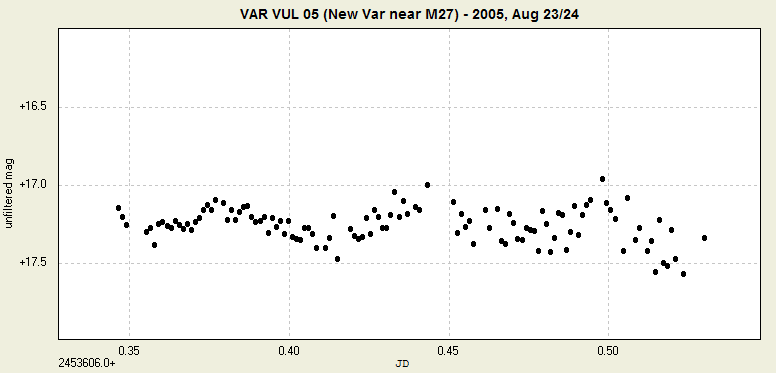
Var Vul 05 unfiltered CCD
photometry light curve. CBA Belgium Observatory.
I then used a number of different period analysis
methods in Peranso
(ANOVA, Lomb-Scargle, PDM, CLEANest) and they all show a strong signal at 0.058
+/- 0.003 d. The corresponding phase diagram
shows a clear superhump profile. Hence, it is safe
to conclude that this object is a new UGSU-type
dwarf nova (and maybe even an UGWZ-type dwarf
nova). The superhump amplitude is about 0.3 mag.
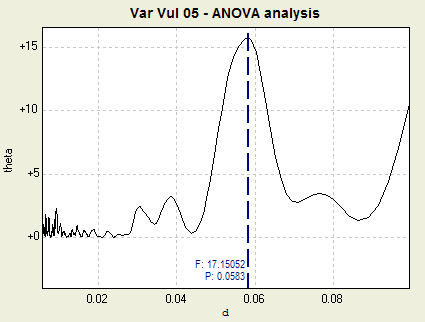
ANOVA diagram showing the
superhump period at 0.058 d.
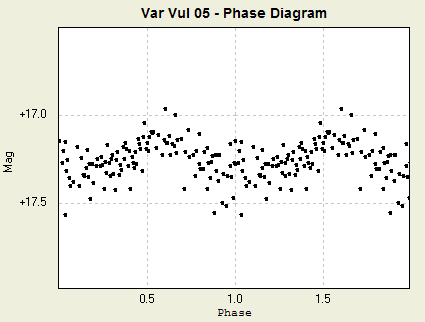
Phase diagram showing the Var Vul
05 lightcurve folded over a period of 0.058d.
On Aug 25/26, 2005, my colleague Brian Martin
from CBA Alberta (Canada) succeeded in confirming
above findings. He detected superhumps too with an
amplitude of 0.3 mag, and found a superhump period
of 0.058 +/- 0.003 d, using Peranso's Anova
method.
On Aug 27/28, 2005, I had another clear night
over CBA Belgium Observatory, and using a 0.35-m
f/6.3 telescope with unfiltered ST-7XME camera, I
started another run on Var Vul 05. This time, the
session lasted for 3.1 hours (till clouds made
further photometry impossible). The variable had
faded to about mag 17.8 (see lightcurve below), but
still showed superhumps with an amplitude of about
0.2 mag. Combined with my observations of Aug 23/24,
2005, I found a superhump period of 0.0590 +/-
0.0002d.
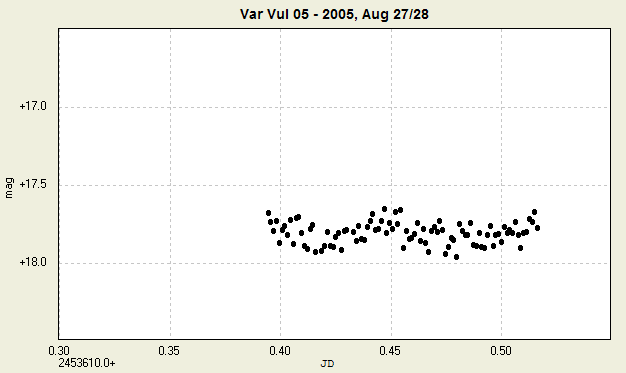
Var Vul 05 unfiltered CCD
photometry light curve. CBA Belgium Observatory.


